Inflation, Monetary Policy and RBI
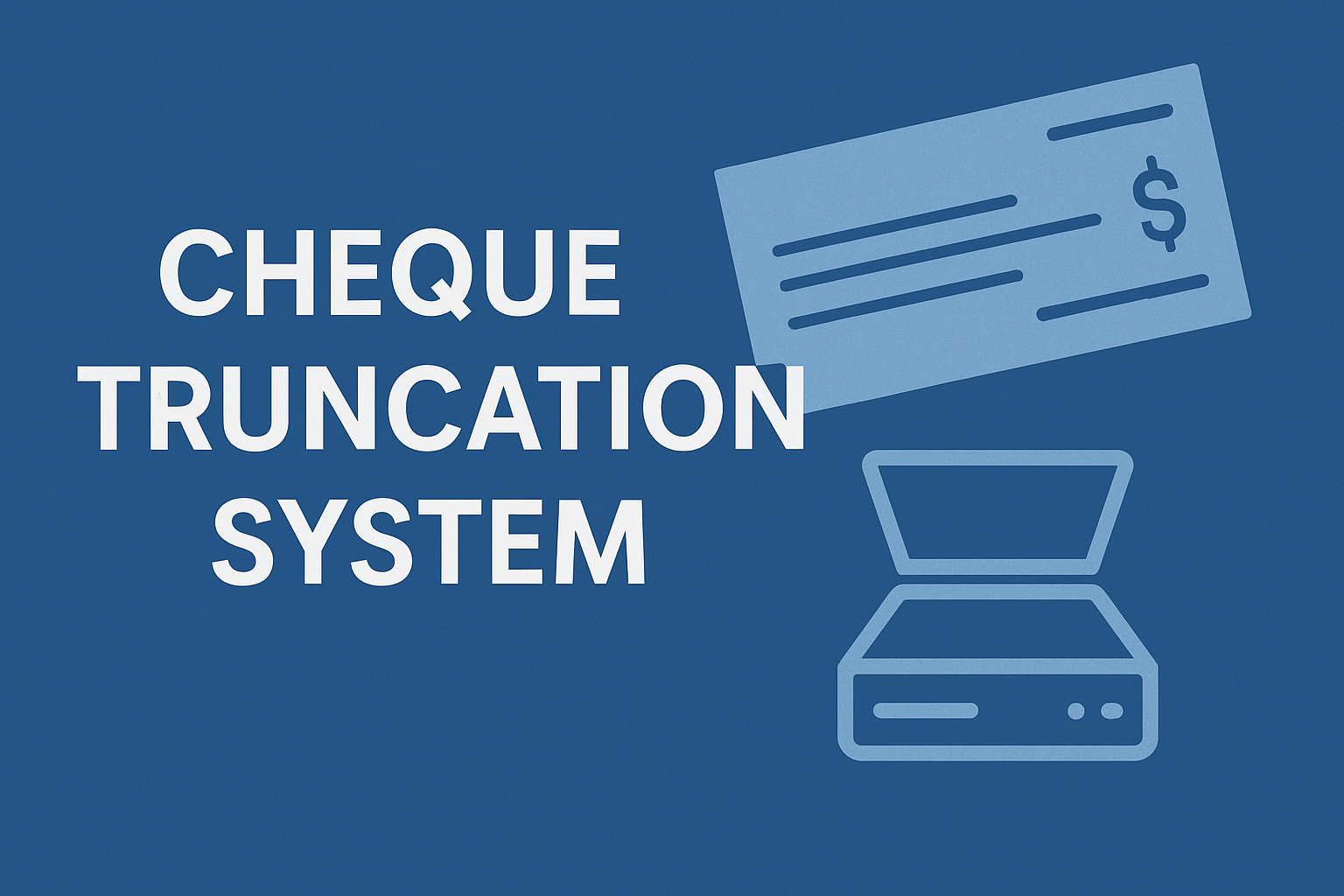
What is the Cheque Truncation System (CTS)?
WHAT?
The Cheque Truncation System (CTS) is a process introduced by the Reserve Bank of India (RBI) to streamline and expedite cheque clearing by replacing the physical movement of cheques with digital images and electronic data. It enhances efficiency, reduces costs, and minimizes risks associated with traditional cheque processing.
CTS is an electronic cheque-clearing system where the physical cheque is "truncated" (stopped) at the presenting bank, and its digital image, along with relevant data (e.g., MICR code, date, amount), is transmitted to the drawee bank via a clearing house for processing. This eliminates the need for physical cheque transport, speeding up the clearing process.
Process
- Presentation: The payee deposits the cheque at their bank (presenting bank), which scans the cheque to capture its image and details (e.g., Magnetic Ink Character Recognition (MICR) code, amount).
- Transmission: The digital image and data are sent to the clearing house (operated by the National Payments Corporation of India (NPCI) under RBI oversight).
- Clearing: The clearing house forwards the data to the drawee bank (payer’s bank) for verification and approval.
- Settlement: The drawee bank confirms (positive for honored, negative for dishonored cheques), and funds are transferred between banks, with the payee’s account credited.
- Security: Digital signatures, encryption, and QR codes ensure authenticity and prevent fraud.
Current and future mechanism
Current : CTS operates on a batch processing model, where cheques are cleared in batches, typically within T+1 days (up to two working days).
Cheques are processed in designated sessions, with physical truncation at the presenting bank but requiring inter-bank coordination, which can cause delays.
New Mechanism (Effective October 4, 2025): The RBI is transitioning CTS to Continuous Clearing and Settlement on Realisation, reducing clearance time to a few hours during business hours. Key changes include:
Phase 1 (October 4, 2025 – January 2, 2026):
Continuous Scanning: Cheques are scanned and sent to the clearing house during a single presentation session (10:00 AM to 4:00 PM).
Confirmation Deadline: Drawee banks must confirm (positive or negative) by 7:00 PM, or cheques are deemed approved and settled that night.
Phase 2 (From January 3, 2026):
T+3 Hour Confirmation: Cheques must be confirmed within 3 hours of receipt (e.g., cheques received between 10:00 AM and 11:00 AM confirmed by 2:00 PM).
Fund Release: Presenting banks must credit funds within 1 hour post-settlement, subject to safeguards.
Non-confirmed cheques within 3 hours are deemed approved.
Practical Example
Phase 1: A customer deposits a cheque at 11:00 AM on October 4, 2025. The presenting bank scans and sends it to the clearing house immediately. The drawee bank must confirm by 7:00 PM, or the cheque is deemed approved, with funds credited that night.
Phase 2: A cheque deposited at 10:30 AM on January 3, 2026, requires confirmation by 1:30 PM. If honored, funds are credited by 2:30 PM, ensuring near-real-time access.
Customer Impact
Faster Liquidity: Funds are available within hours, not days.
Better Predictability: Same-day confirmation reduces cash flow uncertainty.
Bank Accountability: Automatic approval for non-confirmed cheques prevents delays.
Lower Settlement Risk: Faster processing minimizes risk exposure.
Benefits of CTS
Speed: Reduces clearing time from up to two days to hours, improving liquidity for individuals and businesses.
Efficiency: Eliminates physical cheque transport, reducing costs and logistical delays.
Security: Digital imaging and encryption minimize fraud risks (e.g., cheque tampering).
Risk Reduction: Faster settlement lowers counterparty and operational risks for banks.
Customer Experience: Enhances predictability and reliability of cheque-based transactions.
Historical Context in India
- Introduction: CTS was rolled out in India in 2010 in major cities (e.g., New Delhi, Chennai, Mumbai) and expanded nationwide by 2013, replacing traditional paper-based clearing.
- Impact: Reduced clearing times from 3–7 days to T+1 days, standardized cheque formats (e.g., CTS-2010 compliant cheques with MICR codes), and improved fraud detection.
- Technology: Operates through NPCI’s National Electronic Clearing Service (NECS) and grid-based clearing houses in key regions (e.g., Northern, Southern, Western grids).
About author

Zinkpot — We Inform, You Perform.
Ask Anything, Know Better
अपना प्रश्न पूछें
-
What is Food Credit and Non Food Credit?
April 08 What is Non food credit? Non-Food Credit is used to measure how much bank lending is going to sectors other than government food procurement operations. It is an important indicator of real economic activity and private sector demand for loans. Non-Food Credit : Non-Food Credit = Total bank credit – Food credit It refers to loans given by banks to sectors like: Industry Services Agriculture Retail / Personal loans MSMEs Infrastructure Trade and commerce Non-Food...
-
FREE Credit Card का सच!
October 25
-
What is Deposit Insurance? No worries on bank collapse!
October 10
-
What are unclaimed deposits with Banks?
September 24 What Are Unclaimed Bank Deposits? Unclaimed deposits are balances lying in savings accounts, fixed deposits, recurring deposits, or other bank accounts that have had no customer activity for 10 years or more. After this period, banks are required to transfer these amounts to the Depositor Education and Awareness Fund (DEAF), maintained by the Reserve Bank of India (RBI). Importantly, these deposits are not forfeited. Depositors or their legal heirs can still claim the money at any time through the bank, which then seeks...
-
What is a Forward Rate Agreement (FRA)?
August 13 WHAT? A Forward Rate Agreement (FRA) is a financial contract between two parties to lock in an interest rate for a future period, used primarily to hedge against or speculate on interest rate fluctuations. It is an over-the-counter (OTC) derivative instrument, meaning it is customized and not traded on exchanges. An FRA is an agreement to exchange a fixed interest rate for a floating interest rate (based on a reference rate like MIBOR in India or SOFR globally) on a notional amount for a specified future period. It is...
-
Why do the banks demand a minimum balance in the bank account?
August 09 CONTEXT ICICI Bank hikes minimum account balance for urban areas to ₹50,000. But why is minimum balance required? Banks often require a minimum balance or deposit as part of opening and maintaining an account, though the terms can sometimes overlap. A minimum opening deposit is the initial amount (typically ₹2000-₹10,000) needed to fund and activate a new account, while a minimum balance refers to an ongoing requirement to keep a certain amount in the account to avoid fees or penalties. KEY...
-
What is NARCL, a government bad bank?
August 04 WHAT? The National Asset Reconstruction Company Limited (NARCL), often referred to as India’s “bad bank,” was established to address the issue of non-performing assets (NPAs) in the Indian banking system. It was announced in the Union Budget 2021–22 and incorporated on July 7, 2021, under the Companies Act, 2013, with registration as an Asset Reconstruction Company (ARC) under the Securitisation and Reconstruction of Financial Assets and Enforcement of Security Interest (SARFAESI) Act,...
-
What is RBI's Financial Inclusion Index (FI-Index)?
July 23 WHAT? The Reserve Bank of India (RBI) publishes the Financial Inclusion Index (FI-Index) annually to measure the extent of financial inclusion across India. Financial inclusion means including more and more people in the formal banking network. The FI-Index is a comprehensive metric that quantifies financial inclusion on a scale from 0 (complete financial exclusion) to 100 (full financial inclusion). It incorporates 97 indicators across banking, investments, insurance, postal, and pension sectors, developed in...
-
About Society for Worldwide Interbank Financial Telecommunication (SWIFT)
July 21 WHAT? The SWIFT system (Society for Worldwide Interbank Financial Telecommunication) is a global messaging network that facilitates secure, standardized, and reliable communication for financial transactions between banks and financial institutions worldwide. It plays a critical role in international finance, including India’s oil trade with Russia. Main Points About the SWIFT System Definition and Purpose: SWIFT is a cooperative society founded in 1973, headquartered in La Hulpe,...
-
Difference between UPI, AEPS and PPI payment technologies
July 07 WHAT? The Unified Payments Interface (UPI), Aadhaar Enabled Payment System (AEPS), and Prepaid Payment Instruments (PPI) are distinct digital payment systems in India, each serving unique purposes and user bases. Differences Aspect Unified Payments Interface (UPI) Aadhaar Enabled Payment System (AEPS) Prepaid Payment Instruments (PPI) Definition Real-time mobile-based payment system enabling instant bank-to-bank transfers using Virtual Payment Addresses...
Comments
Write Comment