CURRENT NEWS
Where does the RBI’s surplus come from? | Explained
SUMMARY
The Reserve Bank of India's (RBI) surplus primarily originates from its core operations, including interest earnings on foreign assets, gains from foreign exchange transactions, and income from domestic securities.
For the fiscal year 2024-25, the RBI is projected to transfer a record surplus of ₹2.69 lakh crore to the government, marking a 50% increase from the ₹2.1 lakh crore distributed in the previous fiscal year. This substantial rise is attributed to robust gross dollar sales, higher gains from foreign exchange transactions, and anticipated growth in interest income.
The RBI's surplus serves as a significant non-tax revenue source for the government, aiding in fiscal management and funding public expenditures. However, it's crucial to recognize that such surpluses are subject to fluctuations based on global financial conditions, exchange rate movements, and domestic economic factors.
SOURCES OF RBI'S INCOME
- Interest Income from Foreign Assets : RBI holds a large portion of India’s foreign exchange reserves in the form of foreign government bonds, mainly U.S. Treasuries. It earns interest income on these bonds. This is one of the largest sources of RBI’s surplus.
- Interest from Domestic Assets : RBI holds Government of India securities (G-Secs) and earns interest on them. It also earns interest from lending to banks (via repo operations, MSF, etc.) and from its Liquidity Adjustment Facility (LAF).
- Forex Operations (Gains from Currency Movements) : When RBI buys/sells foreign currencies in the forex market to manage the rupee's exchange rate, it can earn profits due to exchange rate fluctuations. For example, a depreciating rupee can increase the rupee-value of RBI’s foreign holdings.
- Revaluation Gains : RBI revalues its gold and foreign currency reserves at the current market rate. If gold prices or foreign currency values rise, RBI records mark-to-market gains. These are notional gains but add to the surplus when realized.
- Fees and Other Income such as Income from the fees on banking services it provides (like currency management, bank settlements). Penalties on banks. Management fees from handling government securities.
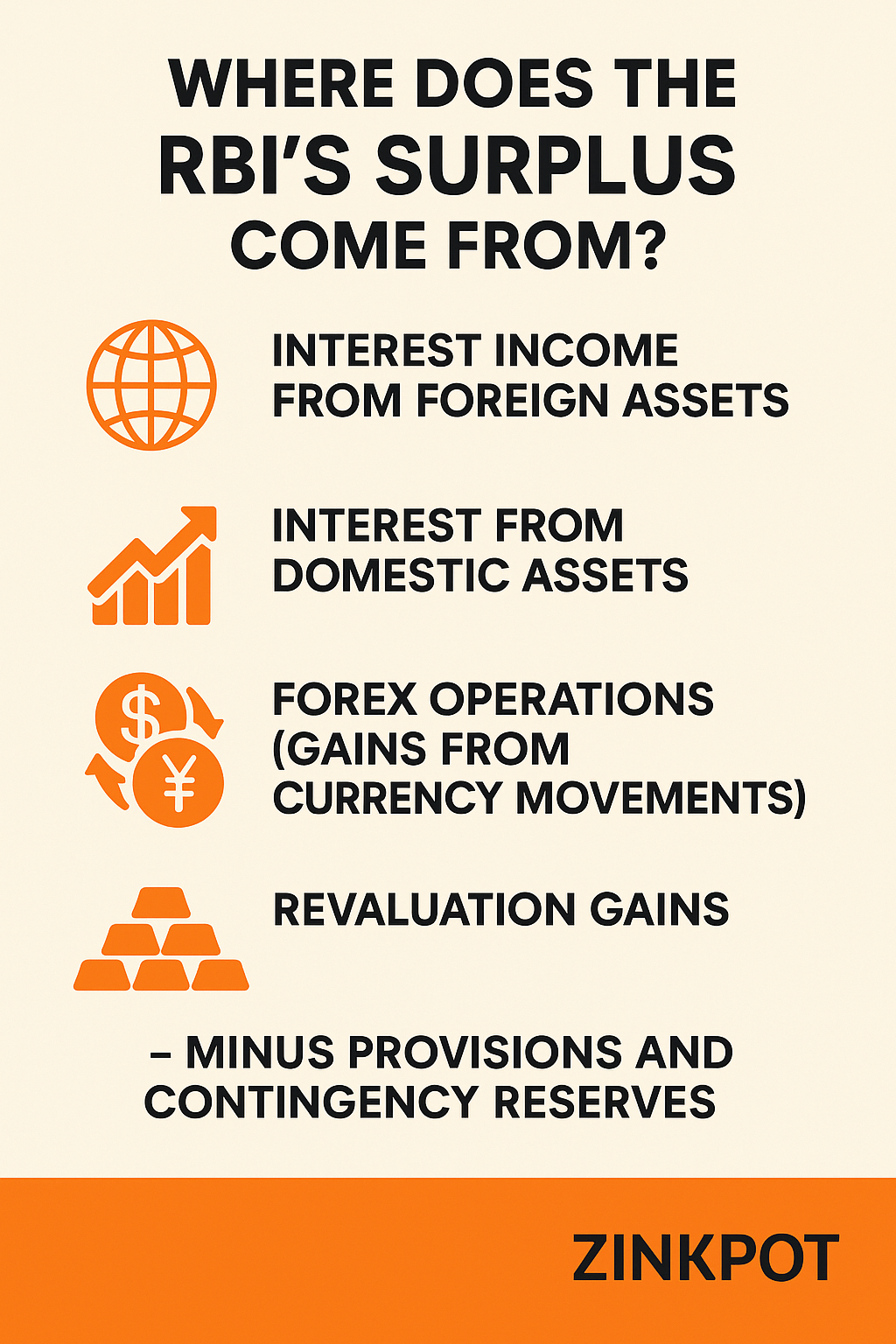
RBI'S DEDUCTIONS : RBI sets aside a part of its earnings for:
- Contingency Fund (CF)
- Asset Development Fund (ADF)
After deducting these, the net surplus is transferred to the Government of India.
Example (FY 2024-25): RBI transferred a record ₹2.4 lakh crore to the government.
About author

Zinkpot — We Inform, You Perform.
Ask Anything, Know Better
अपना प्रश्न पूछें
-
RBI’s balance sheet for FY25 expands by 8.20% YoY to Rs 76.25 lakh crore, says annual report
May 30 HOW MUCH IS RBI'S BALANCE SHEET? In its Annual Report for FY2024–25, the Reserve Bank of India (RBI) announced an 8.2% year-on-year expansion of its balance sheet, reaching ₹76.25 lakh crore as of March 31, 2025, up from ₹70.47 lakh crore the previous year. Key Highlights Asset Growth Drivers: The increase on the assets side was led by a rise in gold holdings (up 52.09%), domestic investments (up 14.32%), and foreign investments (up 1.70%). Income and Expenditure:...
-
How does the RBI earn?
May 26 WHY IN NEWS? Reserve Bank of India (RBI) has transferred a dividend of 2.69 lakh crores to the government for the financial year 2024-25 marking a 50% increase from the ₹2.1 lakh crore distributed in the previous fiscal year. The RBI is a not-for-profit organization then how did it make such huge profits to transfer this huge dividend to the government? SOURCES OF RBI'S INCOME? The Reserve Bank of India's (RBI) surplus primarily originates from its core operations, including interest...
Comments
Write Comment